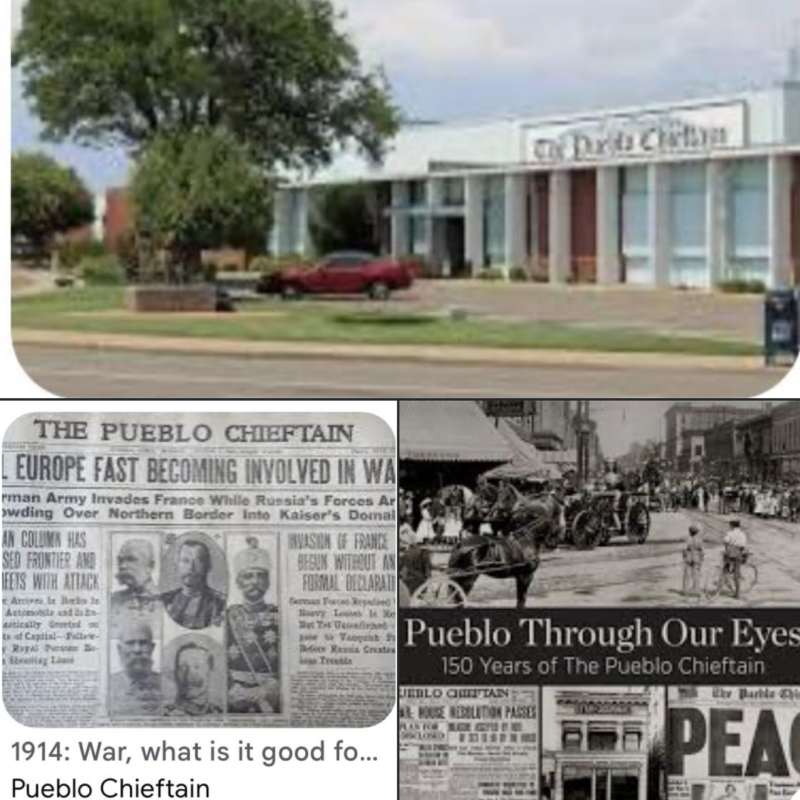
The Pueblo Chieftain was indeed a critical business engine for southern Colorado, operating far beyond a typical local news outlet. Established in 1868, it functioned as a “printing powerhouse” that actively drove the region’s industrial advancement through commercial services and advocacy.
Pueblo Star Journal
* Commercial Printing Hub: In its early years, the Chieftain operated “job presses” that performed commercial work for local businesses alongside printing the daily paper. This provided essential communication tools—such as forms, circulars, and ledgers—for the burgeoning industrial sector.
* Industrial Advocacy: The paper adopted a “battle cry” for Pueblo’s industrial growth. It famously supported the Santa Fe Railroad’s expansion through the Royal Gorge and promoted the development of the Colorado Fuel & Iron (CF&I) steel mill, which became the “Pittsburgh of the West”.
* Market Data & Infrastructure: Early editions provided critical economic information, including agricultural prices and reports on geography that guided pioneers and developers in the Colorado Territory.
* Technological Leadership: To meet high demand, the Chieftain was an early adopter of industrial technology, installing a steam engine to run its presses as early as 1876.
* Promotion of Large Institutions: The newspaper’s owners fought to secure major economic anchors for Pueblo, including the state fair, the Pueblo Dam, and a college.
* Business Mission: The editorial board’s stated mission was to ensure the city would “grow and flourish” industrially and socially, treating the newspaper as a tool for community advancement
The relationship between The Pueblo Chieftain and the Colorado Fuel and Iron (CF&I) steel mill was one of deep economic interdependence that shaped Colorado’s early political landscape. While the mill provided the industrial “muscle,” the Chieftain acted as the region’s primary “voice,” often navigating the complex and sometimes violent tensions between powerful corporate interests and a growing labor movement.
The Chieftain and CF&I grew up together, forming the backbone of Pueblo’s identity as the “Pittsburgh of the West”.
The steel mill and its ownership by the Rockefeller family transformed Pueblo into one of the most diverse cities in the American West, creating a unique social dynamic that The Pueblo Chieftain and other local media had to navigate.
The Rockefeller Impact:
John D. Rockefeller Jr. held a majority stake in Colorado Fuel and Iron (CF&I) from 1904 to 1944. His influence went beyond simple ownership, introducing “welfare capitalism” to manage a massive, diverse workforce.
* The “Rockefeller Plan”: After the 1914 Ludlow Massacre, Rockefeller implemented an Employee Representation Plan—often called the “Rockefeller Plan”—to provide workers a voice without formal unionization.
* Sociological Department: Under Rockefeller’s leadership, CF&I’s Sociological Department, led by Dr. Richard Corwin, aimed to “Americanize” the immigrant workforce. They provided housing, schools, and health care at Minnequa Hospital while teaching middle-class values, hygiene, and English to remove “socialist influences”.
* Community Infrastructure: Rockefeller funded the construction of YMCA branches and community centers in mining and steel towns, creating civic spaces for families to deter workers from “vices” like drinking or attending union meetings.
By 1916, more than 42 languages were spoken at the mill, with workers arriving from over 30 countries.
* A Global Workforce: Major groups included Italians, Slovenians, Greeks, Mexicans, and Slovaks. These groups lived in ethnically rooted neighborhoods like Bessemer, where specific languages like Italian were often the primary tongue.
* Information Hubs: While the Pueblo Chieftain remained the dominant English-language business voice, Pueblo supported approximately 20 foreign-language newspapers in the early 20th century to serve these distinct enclaves.
* Corporate Communication: To reach non-English speakers, CF&I published Camp and Plant, a magazine that tied the company’s various operations together and shared hygiene and civics lessons. The mill even used colored stripes on hospital floors to help non-English speakers navigate to the correct doctors.
Article written by Keith Guerrero and shared on his Facebook page on April 15, 2026