To learn more about Trinidad, visit HERE
A Collection of Photos in no Particular Order
Panoramic View of Trinidad, 1885-1895
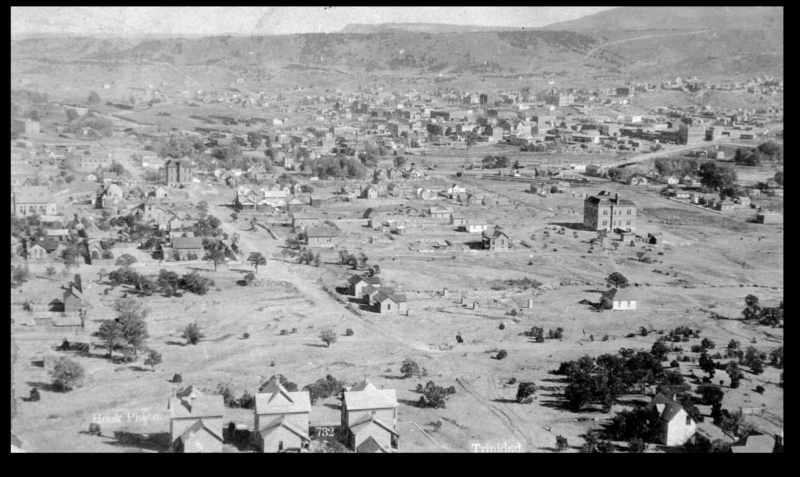
Scene includes the school, a stone church, the First National Bank Building and the County courthouse.
Photo by Hook, W. E. Denver Public Library Special Collections, X-1935
Carpenter Shop
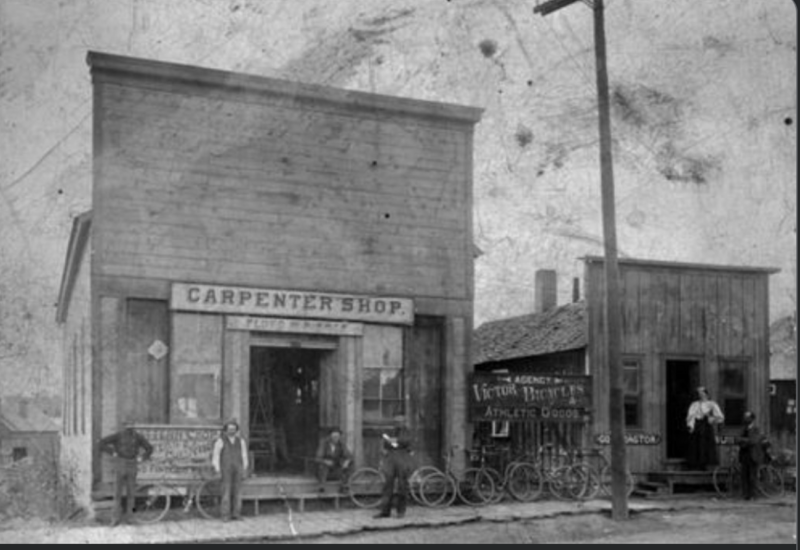
Check out this historic photo of Trinidad in the late 1800s!
The image shows individuals with bicycles in front of a false fronted building that is hosting a carpenter’s shop.
Photo credit: https://bit.ly/4r0nvIM
1909 Parade on Commercial Street
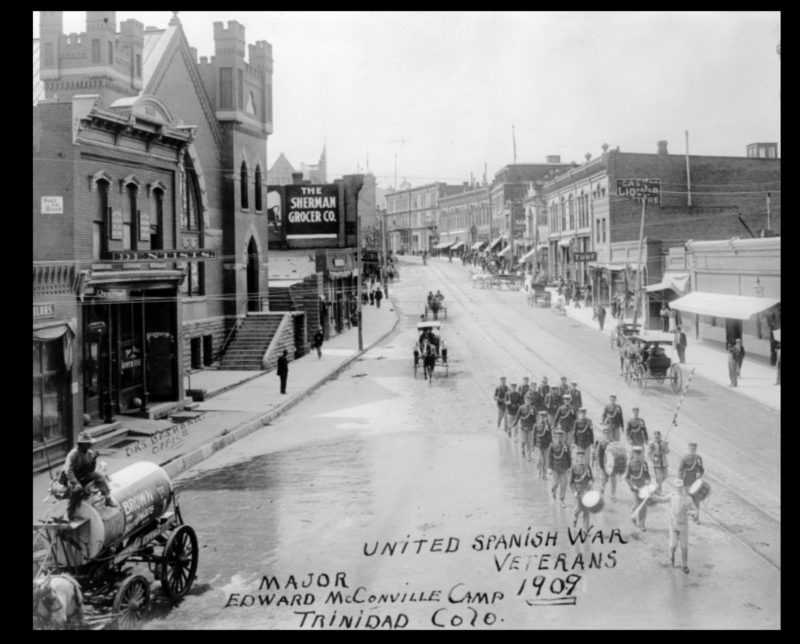
1909 Parade on Commercial Street Shared by the Trinidad Welcome Center Facebook Page
Check out this historic Trinidad photo from 1909! This image depicts a parade on Commercial Street. One and two- story buildings include elaborate tin cornice with end corbels and pedimented window heads. The First Presbyterian Church (1902) has crenelated towers and gothic arched windows. Lettering on a building reads: “The Sherman Grocer Co.” Surreys, buckboards and pedestrians are in the street, and in the foreground, a marching band approaches. A horse drawn water truck with lettering “Brown the Hardware” is in the foreground.
Image credit: https://bit.ly/4aQKFfU
Train Arriving in Trinidad, 1933
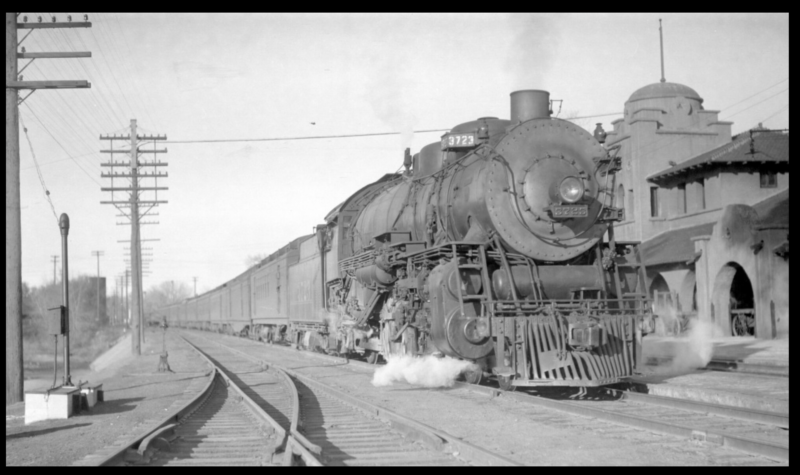
Train Arriving into Trinidad. Photographed: April 16, 1933.
Photo credit: https://bit.ly/4rnms6E
The Chronicle News Building
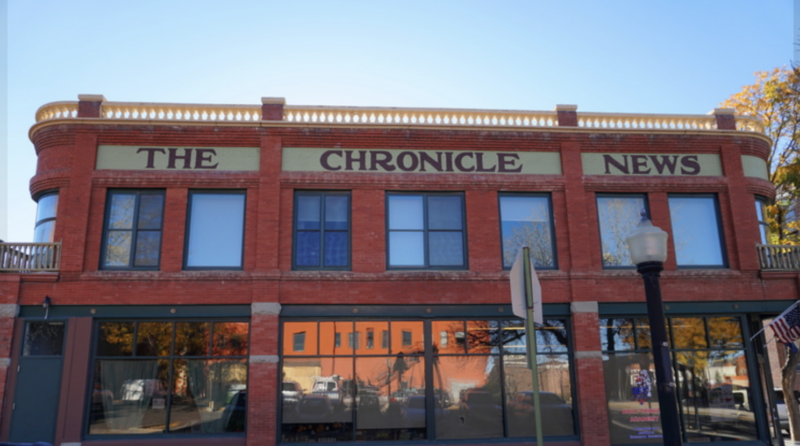
The Chronicle-News Building History Shared by the Trinidad Welcome Center Facebook Page:
The Chronicle-News Building, located at 200 Church Street in Trinidad, Colorado, was constructed in 1900, with a second story added in 1912. The newspaper itself adopted hot lead type composition as early as 1887.
Since 1876, The Trinidad Chronicle-News has been an integral part of the Trinidad community. It has chronicled the town’s evolution, from its origins as a mining camp and the era when Bat Masterson served as town marshal, through periods of floods and fires, prosperity and hardship, serving as a constant presence in the lives of generations of residents.
In the pre-radio era of the 1908 national elections, the newspaper innovatively shared returns by handwriting updates on glass slides for a stereopticon, which were then projected onto the wall of the school across the street. For those preferring not to stand outdoors in the November chill, the paper launched skyrockets at predetermined intervals: one rocket if Republicans were leading, and two if Democrats held the advantage.
Although The Chronicle-News no longer occupies this historic building, it remains one of Colorado’s oldest continuously published newspapers. Visit Trinidad
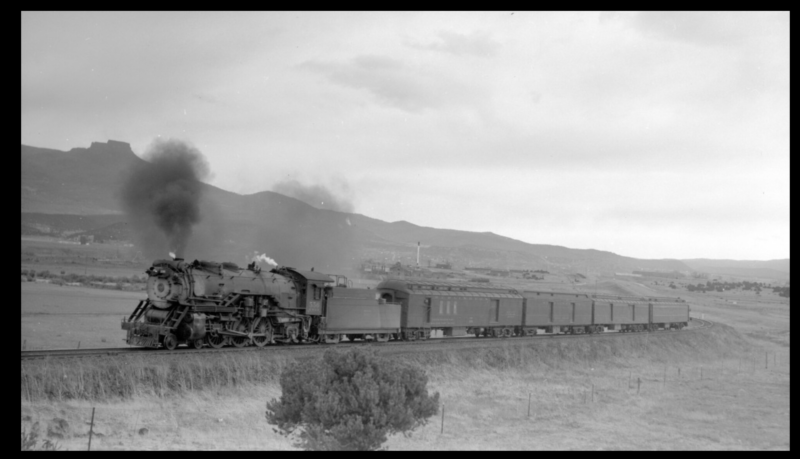
Passenger Train and Fisher’s Peak
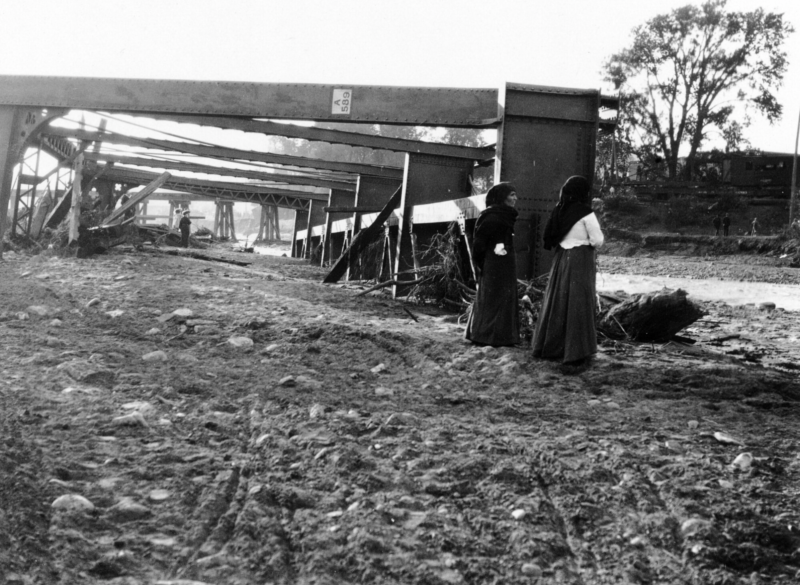
1904 Flood Damage
Simpson’s Rest
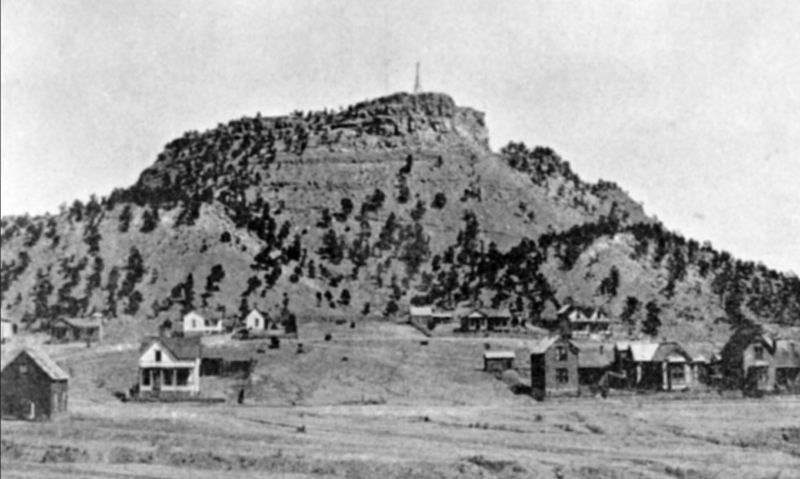
Simpson was a prospector in Colorado and an early settler and documentarian of Trinidad, writing about it for East Coast newspapers.
Denver Public Library Special Collections, X-1885
Shared by the Trinidad History Museum on the Historic Santa Fe Trail Facebook page, June 11, 2026
East Street School
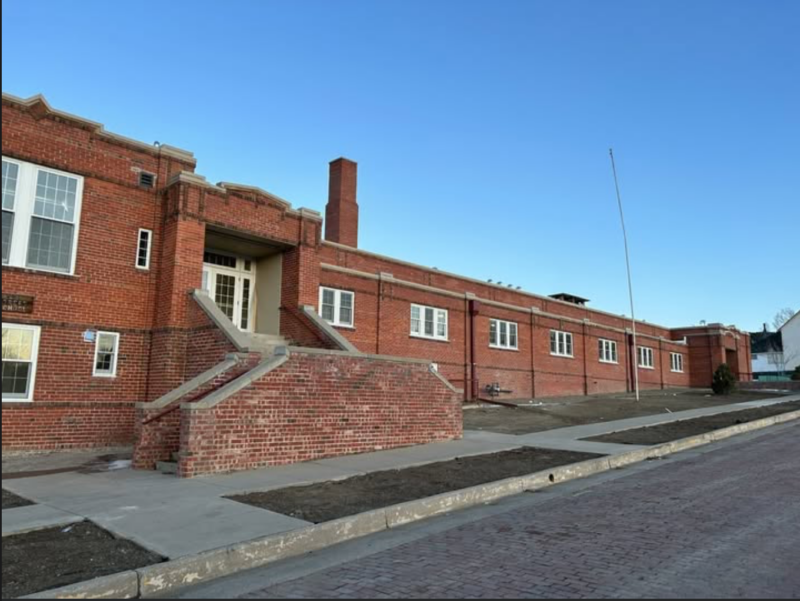
Constructed in 1919 to serve the growing primary school population in an expanding neighborhood some distance east of Trinidad’s center, the East Street School remained in operation for over 80 years.
The prolific architectural firm of Isaac H. Rapp and William M. Rapp, responsible for numerous commercial, religious and residential buildings in Trinidad, designed the brick building. The Rapp brothers designed five public schools in Trinidad of which only two remain.
East Street School represents the diversity of styles in which Rapp & Rapp designed. Unlike their previous schools which were multi-storied contained buildings, the architects created a sprawling one-story layout inspired from California. East Street School represents an innovation in school design that would become popular after World War II.
The school reflects the Arts and Crafts movement in its one-story design, slightly stepped parapets, wall pilasters, and the use of contrasting darker brick for stringcourses and two-dimensional “strap-work” ornamentation.
After faithfully serving the community’s educational needs for decades, the East Street School fell dormant in the early 2000s–until a visionary new owner recognized its potential and embarked on a journey to repurpose this heritage-rich space. The historic rehabilitation of the East Street School returned many architectural features that had faded over time, with the transformed school now functioning as a sustainable live/work community for artists of all disciplines.
Shared by the Trinidad History Museum on the Historic Santa Fe Trail Facebook page, June 14, 2026
Trinidad Opera House
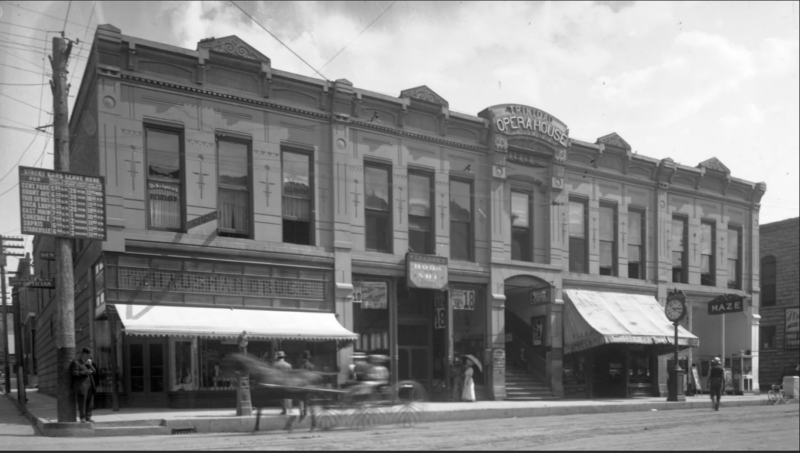
In 1882, Brothers Sam, Sol, and Henry Jaffa opened Trinidad’s first opera house to great fanfare.
It hosted plays, brass bands, public speakers, and other events for twenty-four years before closing in 1906. The practical citizens of Trinidad filled in the old auditorium with a new floor and repurposed the building as an office block and an annex to the nearby Wight Hotel.
The building was still in use when it was badly damaged by a 5.3-magnitude earthquake in 2011. Although some experts recommended demolition, the community rallied to preserve and repair the building.
Image: The Trinidad Opera House between 1905-1915. There is a streetcar timetable on a utility pole and a horse-drawn carriage is in the dirt road. Photo by Otis A. Aultman. History Colorado, 93.322.1824
Shared by the Trinidad History Museum on the Historic Santa Fe Trail Facebook page on June 23, 2026