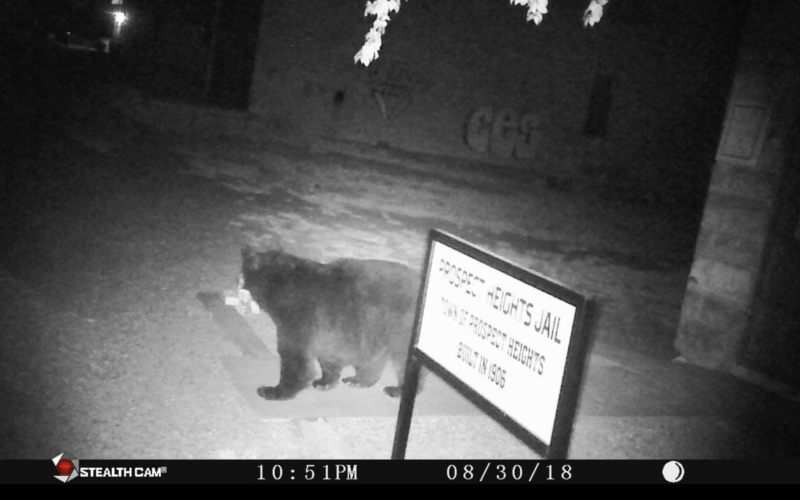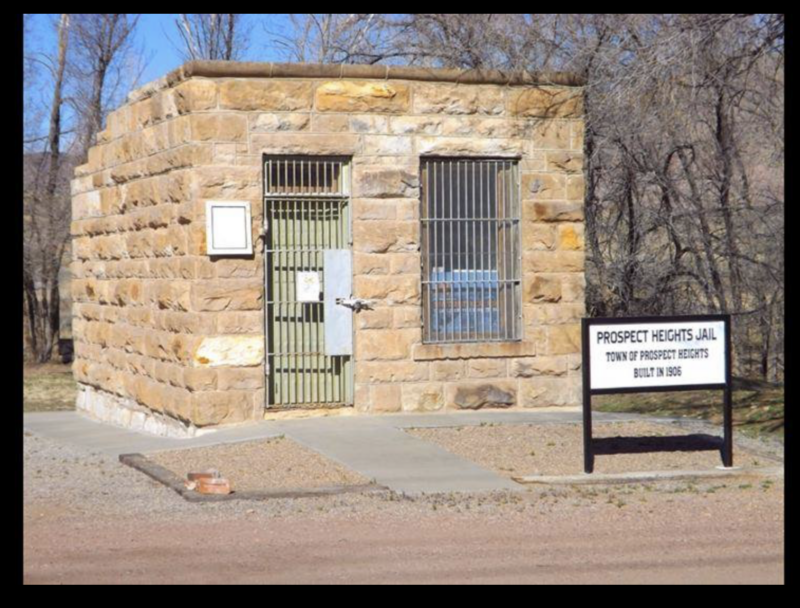
Prospect Heights Jail, photo taken by Deeg Deegers.
From the County Historical Society:
Town of Prospect Heights, previously a Slavic enclave of mine workers near the Nonac Coal Mine. The enterprising residents incorporated in 1905 to take advantage of absence of saloons in the neighboring “dry” communities of Cañon City and South Cañon. The jail was built to incarcerate the disorderly drunks who frequented the seven or eight saloons and other establishments operating twenty-four hours a day.
Its size, setting and construction of native stone from an outcrop of yellow ochre concretionary sandstone from nearby Eagle Wing make it a visual landmark in this small community.
In 1901 Cañon City had repealed the ordinances granting liquor licenses in the city, effectively closing its six saloons. The back-and-forth battle over the temperance movement went on for years, strengthened by 1905 with support from the City’s 14 churches, four hospitals, several active women’s groups including the Women’s Christian Temperance Union (WCTU), two newspapers and a month-long revival by evangelist Billy Sunday. Another ordinance was enacted prohibiting the sale of alcohol in June 1905.
Prospect Heights glory days ended in 1909 when the U. S. Smelter closed down, hurting business, and the saloons were threatened with legal actions. In September 1909, supported by a Colorado
Supreme Court decision upholding local option laws banning alcohol sales, the saloons in Prospect Heights were all closed. This was later reinforced when Colorado became one of the first states in the Union to enact a statewide prohibition law closing all saloons in 1916, followed in 1920 by the ratification of the 18th Amendment, establishing prohibition in the United States until repealed by the 21st Amendment in 1933.
The last time the jail was used as a detention facility was in 1914 when U.S. Army troops were called into the area to quell the violent Coal Strike of 1914.
The Prospect Heights Jail was added to the Colorado Register of Historic Places as 5FN.1803 on March 12, 2003. It is also listed as a Fremont County Landmark in 2014.
By 1990, the town’s water system was failing and residents petitioned to tap into Cañon City’s water system. Cañon City government passed a resolution that allowed Prospect Heights to be added to their water lines, but the town needed to disincorporate. After paying a $250 water tap fee, the town dissolved and began receiving water service from Cañon City, even though it is not part of the City.
Today, the Jail is owned by the Fremont County Historical Society, which periodically opens the building to the public and conducts tours.